As rates of pediatric myopia (nearsightedness) continue to climb worldwide, families and eye care professionals are eagerly seeking effective interventions. Among the newer solutions entering the market is repeated low-level red light therapy. Promising to slow down myopia progression, these compact devices have quickly gained traction in clinics and homes alike.
However, behind the promising headlines, a critical question remains: Are these devices safe for daily eye exposure?
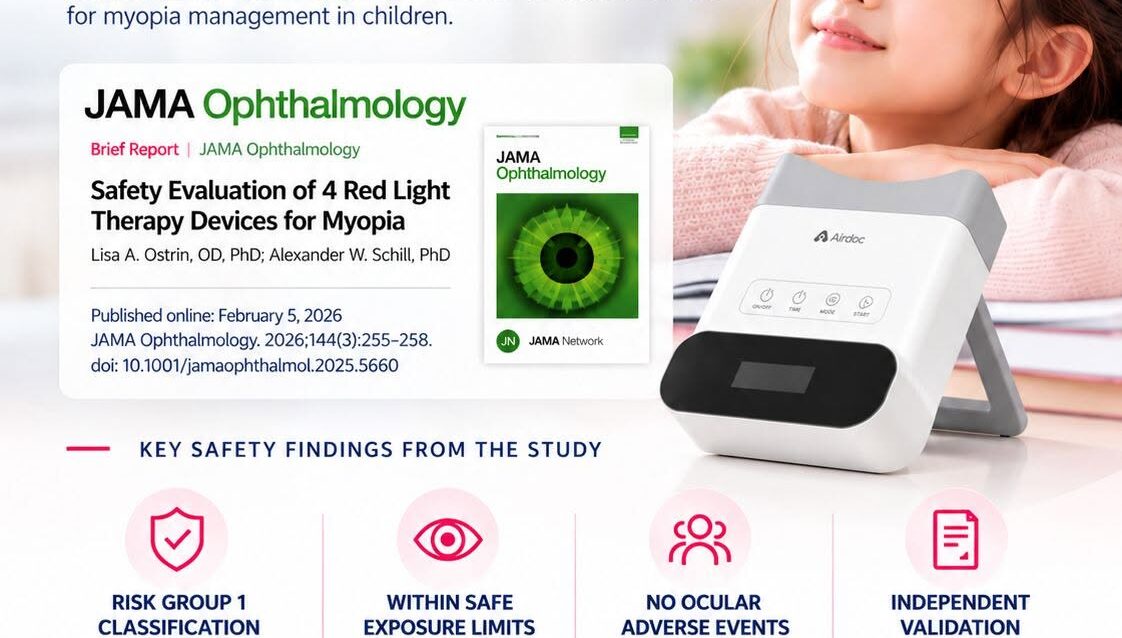
A quality improvement study conducted by researchers at the University of Houston and published in JAMA Ophthalmology evaluated several popular red light therapy units against established safety standards. Here is a breakdown of what the research uncovered and what it means for consumers.
Assessing the Safety Standards
To test whether these devices pose potential risks to the retina, researchers evaluated four commercially available instruments used for myopia management: the Sky-n1201, Future Vision, EyeRising, and AirDoc.
The devices were tested using parameters established by the American National Standards Institute (ANSI) to determine how long an eye could safely be exposed to their light emission before reaching Group 1 safety limits.
Key Findings: Lasers vs. LEDs
The study revealed a stark contrast in safety profiles based on the underlying technology of each device:
- Laser-Based Devices: Instruments relying on red laser light crossed official safety thresholds in a matter of seconds under standard testing conditions.
- The EyeRising device reached maximum ANSI safety limits in just 1.4 seconds.
- The Sky-n1201 reached safety limits in 2.8 seconds.
- Both devices surpassed allowable limits long before the standard recommended treatment session of 180 seconds was complete.
- LED-Based Devices: In contrast, the AirDoc device, which utilizes light-emitting diodes (LEDs) rather than lasers, delivered a much broader, diffuse illumination. It remained well within safe limits even during extended exposure times exceeding 22,000 seconds.
What This Means for the Future of Myopia Management
While red light therapy holds potential as a non-invasive treatment option, these findings emphasize that not all devices are built equal. High-intensity laser devices can deliver concentrated energy to delicate retinal tissues far more rapidly than gentle LED-based equipment.
With emerging clinical reports noting potential ocular risks—and regulatory agencies in regions like China moving to reclassify red laser devices as Class III medical tools—there is a growing consensus in the optical community: independent, rigorous safety validation is essential before these products see widespread pediatric use.
The Takeaway
If you are considering or currently using red light therapy for myopia control, safety should always come first. Consult directly with an optometrist or ophthalmologist to discuss verified, evidence-based treatments and ensure any equipment used meets strict safety certifications.
For more technical details and exact radiometric data, read the complete study in JAMA Ophthalmology.